
A Gift that Welcomes Everyone.
Some legacies are written in names and plaques.
Others are felt quietly, from the moment you walk through the door.
For the Pittaway family, Dunstan Hospital was never just a place of treatment. It was a place of care, safety, dignity, and humanity during some of life’s most tender moments. Over multiple admissions supporting both parents, Julie Umbers saw first-hand what makes Dunstan special and why it matters so deeply to the Central Otago community
That lived experience would ultimately inspire a generous and lasting gift, one that transformed the Vincent Ward reception into a calmer, more welcoming space for every patient and visitor who arrives at Dunstan Hospital.

Dorothy (centre) and Julie (far right)
“It Didn’t Feel Like a Hospital”
Julie often describes Dunstan as different from other hospitals she had experienced.
She recalls. “It feels homely clean, fresh, safe and welcoming.”
That sense of safety came not just from the building, but from the people within it: nurses who took time, doctors who listened, and staff who treated patients and whānau with genuine warmth and respect. The hospital’s smaller scale allowed for deeply personal care, something Julie believes attracts “the best people”.
For Dorothy Pittaway, that atmosphere mattered enormously. In her early nineties, Dorothy was fiercely independent, community-minded, and deeply connected to the people around her. She had volunteered extensively throughout her life, supported local causes, knitted for generations of her family and friends, continued her expertise in making endless dozens of pikelets (with raspberry jam and cream) for family and friends, even fund raising herself ($520) for Daffodil Day, making and selling pikelets at Aspiring Village and remained determined to live on her own terms for as long as possible.
Dunstan respected that independence.
During one hospital stay, the family celebrated Dorothy’s 93rd birthday at Dunstan complete with three cakes, one, a Christmas cake for Dorothy, baked by Julie and given to the staff to enjoy. Dorothy affectionately referred to it as the “Dunstan resort,” a reflection of how comfortable and cared-for she felt there.
Dignity at the End of Life
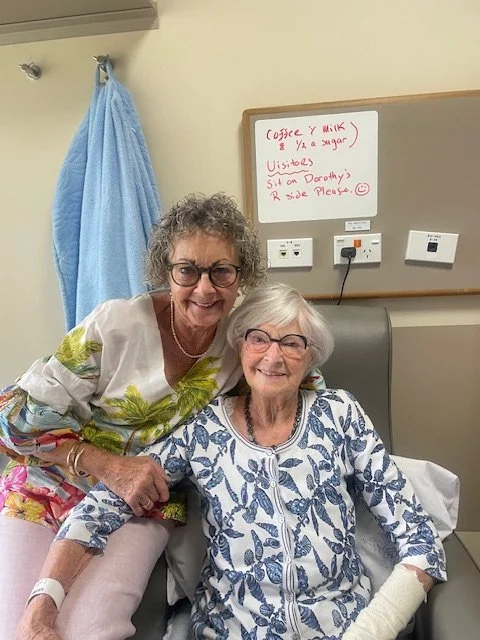
Julie and Dorothy at Dunstan Hospitalˆ
As Dorothy’s health declined, her wishes were clear. She did not want to be resuscitated or placed on life support. She wanted dignity, comfort, and familiarity.
Dunstan Hospital provided exactly that.
Julie was able to be closely involved in her mother’s care, helping with daily tasks, spending meaningful time together, and supporting nursing staff during a demanding period. Rather than feeling powerless, she felt useful, present, and connected. That experience, Julie reflects, is rare and deeply important for families navigating end-of-life care.
There was a profound alignment between Dorothy’s values family, community, generosity and the way care was delivered at Dunstan. It felt like an extension of the life she had lived.
“I Wanted to Do Something Meaningful”
Dorothy and her late husband had always intended to give back. Supporting Dunstan Hospital and St John Ambulance was something they had spoken about for years.
After Dorothy’s stroke, that intention became more immediate.
Julie recalls conversations about how a gift might help others not in a grand or showy way, but in a practical, human way. What would make a difference to families arriving at Dunstan in moments of fear, uncertainty, or grief?
Just as importantly, what would support the staff who meet those families every day often at the very start of difficult journeys. Improving the Vincent Ward reception was about creating a space that worked better for everyone: a calmer first point of contact for patients and whānau, and a more supportive, functional environment for the nurses, administrators, and clinicians who spend long hours caring for others. For Julie and Dorothy, enhancing the experience of staff was inseparable from enhancing care itself.
The answer became clear: the Vincent Ward reception.
As a busy, highly visible entry point, reception sets the emotional tone for a hospital visit. For Dorothy, improving that space meant improving the experience for everyone, patients, whānau, staff, and visitors alike.
Her gift funded the transformation of the Vincent Ward reception into a more calming, welcoming environment, one designed to soften the moment of arrival and offer reassurance from the very first step inside.
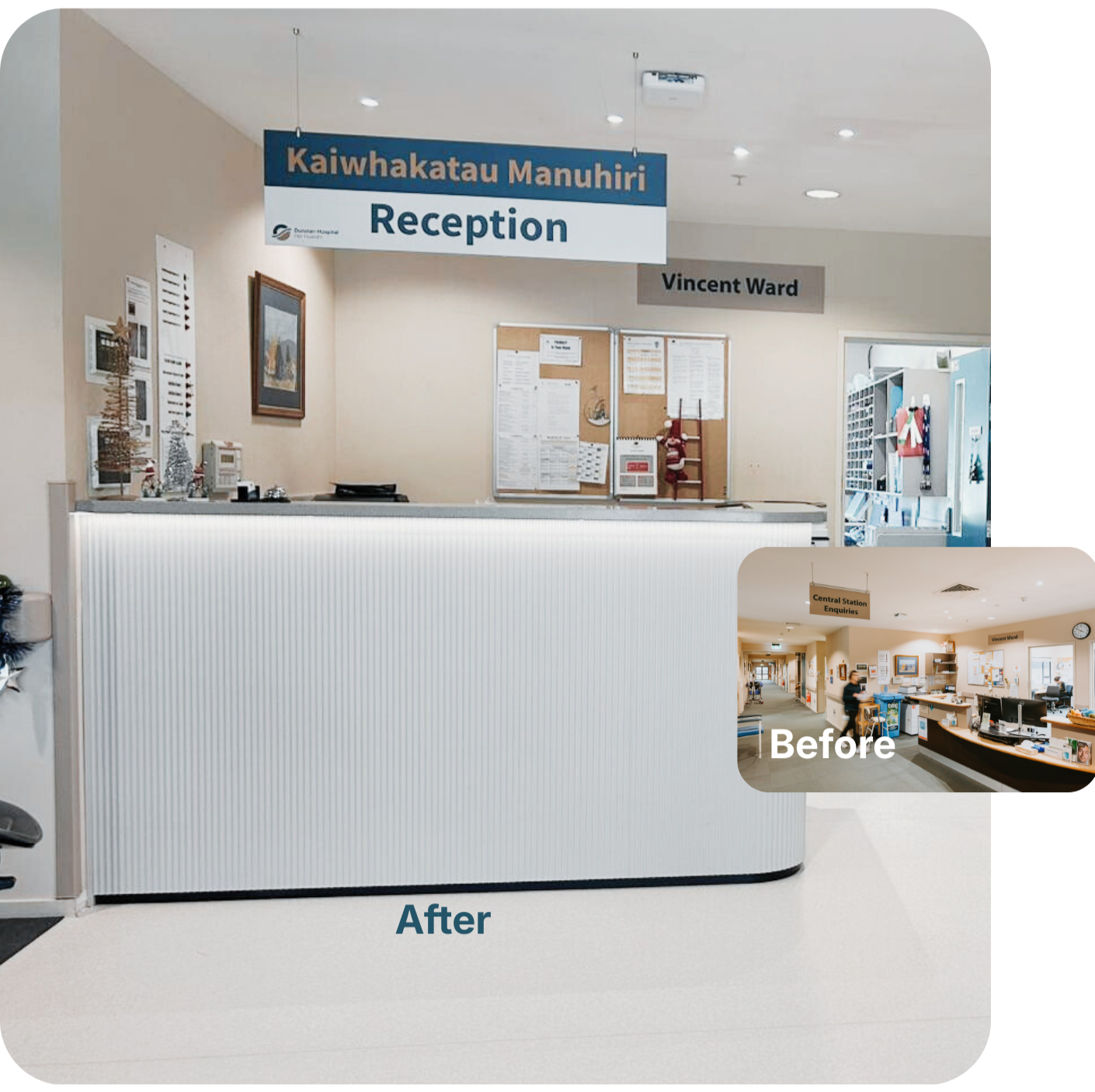
Before and after upgrades to the Vincent Ward Reception
Dorothy Pittaway’s legacy is defined not by its scale, but by its intention. It grew from lived experience and deep gratitude, shaped by a desire to make things better in a way that was practical, human, and enduring. Her gift was about improving the everyday journey for others, creating a space that offers calm, reassurance, and dignity at the very moment people need it most. Today, every person who walks through the doors, or work on the Vincent Ward benefits from Dorothy’s generosity, whether they know her name or not. Her kindness lives on in the feeling of welcome that now greets families and supports staff at Dunstan Hospital. As Julie reflects, the gift was never about recognition. It was about ensuring others could feel the same warmth and sense of safety her family experienced, especially in life’s most vulnerable moments.
Why Stories Like This Matter
Dunstan Hospital has always been shaped by its community. From its early beginnings during the gold rush to its status today as a vital regional health hub, community support has been central to its strength and resilience
Grateful patient stories like Dorothy’s remind us that healthcare is not only funded through systems and policies, it is sustained through people who care deeply about the place and the people within it.
As pressures on rural health services grow, these acts of generosity help ensure Dunstan can continue to provide exceptional, compassionate care close to home.
Every Story Counts
Dorothy Pittaway’s story is one of gratitude, generosity, and legacy. It shows what is possible when lived experience becomes an act of giving and how one family’s kindness can shape the experience of thousands of others.
It begins simply by recognising what moved you, and imagining how you might help future families feel the same.
Every story counts.
If you would like to learn more about grateful patient giving, legacy gifts, or ways to support Dunstan Hospital, visit dunstanhospital.org.nz.