
Stories from the Front Line: Donny
A monthly reflection from inside rural medicine, written by Dr Trevor Lloyd.
One day, as I am prone to do, I walk into Cromwell Paper Plus to look at books. Sometimes I buy one, or come back and buy one later. Other times, I go to the library instead to see if they have anything similar. I am not the type to choose a book at the book shop and buy it on-line. I say hello to Sharon Clark, who has worked there for ages. Sharon's parents, Donny and Marion, have been good friends over the years to my own Mum and Dad. They have had shared interests in farming and sport and in the small community in which they have all lived. Except that everything that Donny has done is bigger and better: he is the owner of Carrick Station; he is an ex All Black; and he arrived in Bannockburn a few years earlier than we did,
Marion and my mother many years ago, when we were living in South Auckland, shared a mystery weekend, a promotion at the time for one of the local airlines. We were hoping they would get the chance to come to Auckland, which they did. They stayed in a hotel in the central city, did some shopping, and went to a show. The rest of the time, they came to our place, and we showed them around the area. I remember we took them to Manukau Heights, at that time a new subdivision looking up the harbour. I told them how many hundreds of thousands of dollars people were paying for a quarter acre section. Marion, though not the one likely to boast, was unimpressed.
"Why?"
"Because of the view."
“Well," she said, "we live on 25,000 acres, and I prefer the view from our place."
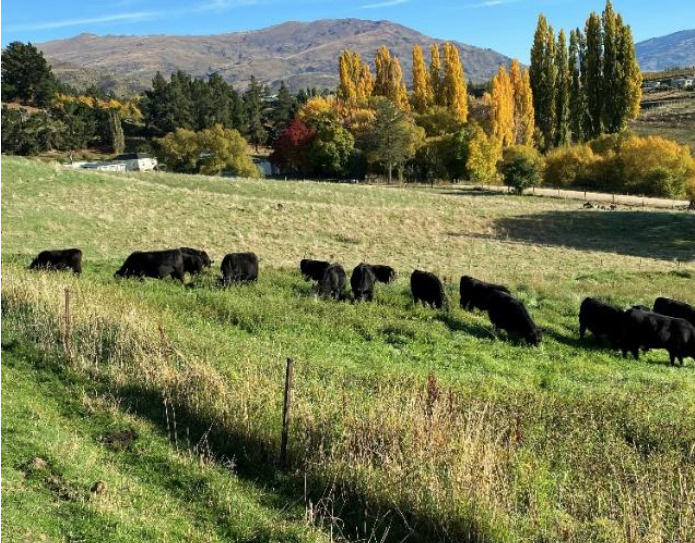
The views from their place are indeed impressive. Since we have been living ourselves back in Bannockburn, we have had a chance to explore the local walks, many of them littered with historic ruins from the gold rush in the 1860s. Nearest is the walk to Stewart town, and above it the Long Gully Loop Track. Further, up a different hill, part of Donny Clark’s place, is Carricktown, the track from there leading up to the Young Australian water wheel, and past it to the crest of the Carrick Range. The walk has views back to Bannockburn and Cromwell and the Upper Clutha valley, and ahead to the high snowy mountains towards Queenstown. In the distance we can see over the Crown Range and up to Mount Aspiring. From the top of the range, there is a long and muddy walk to Duffer's Saddle, also on Donny Clark’s place, a longer walk to Slapjack Saddle, or a shorter walk, requiring permission from another land owner, to link with the Long Gully Loop Track back to Stewart Town.
In the shop, I pause to look at a new rugby book: Richie McCaw 148, named for the number of rugby tests the great test rugby captain had played. Fortunately, I stop myself from suggesting to Sharon that there should be another book called Donny Clark 2, for the two tests her father played in 1964. That would be unfair. First, in those days, there was not the policy of rest and rotation that coaches adopt today. Nor did New Zealand play multiple tests against lesser rugby-playing countries such as Japan or Namibia. Nor were there the liberal substitutions we have now, where all the reserves get a game, and a test cap. Unfortunately for Donny, he was kept out of the test side in his favoured position of open-side flanker by some of the greatest ever All Blacks.
In addition, there was a similarly named player in the All Blacks at the time: Don Clarke, also known as D.B. Clarke, or simply Da Boot, who played 27 tests and scored a record 781 points. Donny, to his shame, was forever known as D.W. Clark, or more ignominiously "the other Don Clarke". In the end, Donny's promising test rugby career was cut short by a farming accident.
None of this stopped the Cromwell Rugby club from prominently displaying his All Black jersey and accompanying photos in the club rooms. Donny went on to play many games for Cromwell. I remember playing with him quite a few years ago when I was a teenager and he was in his thirties.
Donny knows a lot about rugby. He is also a successful and respected farmer. His Angus steers always fetch top price at the Cromwell sale. He is a firm believer in the value of his own opinion on every subject. For the usual conversations about rugby and farming, this is fine, and I have learnt a lot from him. On race relations, or immigration, or gender politics, or land tenure, any discussion is best avoided. I know him best as a farmer. It is a shame that his farming, which he loved, prevented him, as it tended to in those amateur days, from carrying on with his chosen sport.
The first time I eventually got to see Donny as a patient was also after a farming accident. He had crashed what he called, as many people do, his quad bike. This is logically impossible, as a bicycle by definition has two wheels, not four. Effectively, he was injured by an oxymoron. And badly. He had two lines of rib fractures down one side of his chest, and between them what we call a flail segment—when he took a breath in, most of his chest would rise but the injured part would be sucked in. It is a nasty condition, often associated with underlying lung injuries. A CT scan showed nothing too bad inside the chest. Apart from pain relief, we gave Donny oxygen, and tried using positive pressure to the inside of his airways to support the flail segment from within. This didn't work. Most of the air ended up outside the lung in the middle of the chest. In the end, Donny toughed it out, and went back to his farming.
There were other occasions. A year or two later, I heard that a Mr Clark was being admitted to the hospital with abdominal pain. I sent our fifth year medical student, a young English woman, whom I was sure Donny would get on with, to take his history. She returned with a characteristic story of what we call renal colic, a stone passing down the tube from the kidney to the bladder. I suggested that this was the most likely diagnosis. Our student disagreed. Renal colic, she had been taught, is said to be the most severe pain that a person can experience. Women who have had renal colic in pregnancy, then have been through the pain of labour, would rather have the baby. Though no-one has ever had to feed and care for and pay for the upkeep of a kidney stone. However, in terms of diagnosis, when the student had asked Donny how bad the pain was, he had replied, as he was likely to do, "A bit."
I explained to the student that for Donny, an ex All Black and a high country farmer, to leave his farm and go to the doctor because of a bit of abdominal pain, meant the pain must be severe, whatever he said. She remained unconvinced. We went to see him together. Donny gave me the same story. he also told me he had been vomiting. I asked him how the pain compared with his two lines of rib fractures a year or two before. "Well, that was a bit sore too," he said, "but at least I knew what was causing it." We organised a CT scan, which showed a stone in the ureter between his right kidney and his bladder.
There were further problems with stones. A few years later, having passed the previous stone, Donny returned with fever. This time he had no pain, that he would admit to, but an analysis of his urine suggested that something was irritating his urinary tract. Sure enough, there was another stone on CT. We gave him some heavy-duty intravenous antibiotics to treat the infection and arranged with the specialists in Dunedin for the stone to be removed. Donny went back to his farming. I heard from my mother that he had not got round to attending the appointment in Dunedin.
A few months later, one of our registrars, a doctor training to be a rural hospital specialist, received a phone call to say that Donny was sick again. Donny had developed a fever and Marion had called the ambulance. I explained to the registrar that Donny was a close neighbour, almost family, and asked him to take the lead in his care. Donny, as expected, was indeed very sick. He had a high fever, a racing heart, and was starting to develop a low blood pressure. He was becoming confused. The nurses put him on oxygen. The registrar managed to get in a big long intravenous line to take some blood for testing and give fluid and antibiotics, a urinary catheter to test for infection and monitor urine output, and an arterial line to continuously measure blood pressure and monitor blood gases. I watched mainly from a distance, attending to the other patients on the ward, in awe as always of the younger doctor's technical skills.
Things were not going well. Donny was becoming more confused, rambling about things that would have made no sense to most of the staff around him. He was becoming less responsive. His blood pressure, in spite of our efforts, remained low. We started him on some stimulant medicines to try to get the numbers up and perfuse some of his important organs while we waited for a retrieval helicopter from Dunedin. We explained to Marion that Donny might not survive and asked her to call in other family members. They all arrived and sat outside his room—Sharon, her brother Jason, and some others, looking uncomfortable in the unfamiliar hospital environment. As I might have looked to them at a cattle sale or a sheep dog trial.
I stood helplessly, waiting for the helicopter, watching Donny lapse into unconsciousness. It reminded me of the times we had played rugby together, watching Donny lying on the bottom of the ruck, being walked over by all of the opposition forwards, looking like he was going to die. In those days, I remembered, Donny would somehow get himself up of the ground, get hold of the ball, break loose, and score an unlikely try. Donny spotted me standing by his hospital bed.
"Hey," he asked me. "How are those calves you got from Jason?"
"Good."
"We didn't get much for the calves this year."
"I don't remember mine being cheap."
One of the nurses showed some interest in this new effort at conversation.
"Are you a farmer?"
"Yes," he said, but there wasn't much more he could tell her.
"Ask him about rugby," I suggested.
"Who did you play for?"
Suddenly, the fluids, the antibiotics, the stimulant medicines, the oxygen, seemed to be working. Donny was more alert, stronger, his chest swelled.
"I played for the All Blacks," he said.
The helicopter arrived and a slightly improved Donny was flown away to Intensive Care. He survived.
I next saw Donny at a neighbour's son's wedding, held in their orchard next to our boundary, with a view of the life-saving cattle over the fence. Donny was better. The infection this time was centred in his gallbladder and he had it removed. As well as, eventually, the kidney stone. I saw him again at my mother's 90th birthday. But it was only briefly. It was a Saturday, and the Cromwell Seniors were playing that afternoon. After lunch, Donny excused himself to go and watch the rugby, leaving Marion to spend an enjoyable afternoon with the other ladies. I don't know when I will see him again as a patient. I'm sure both of us are happy to wait.
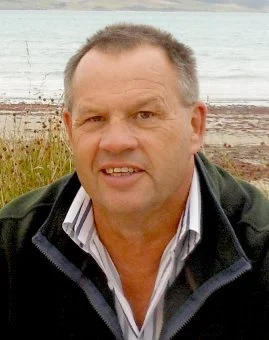
This year marks a remarkable milestone for Trevor Lloyd, one of Dunstan Hospital’s senior clinicians. Trevor has just renewed his medical registration for the 50th time, with 26 of those years spent caring for patients at Dunstan Hospital.
He is a GP, leader, writer, and long‑time advocate for our community, Trevor’s journey from London to Central Otago reflects a life lived in service of others. His creative writing has become a beautiful extension of that care, sharing stories that celebrate the people, places, and quiet acts of kindness that define our region. Whether in the clinic or with a pen in hand, Trevor continues to give back in ways that deeply enrich the Dunstan whānau.